Nearly 4,000 cetaceans observed during 34 monitoring surveys: data collected by CIMA Research Foundation in summer 2026 offer a snapshot of biodiversity in the Pelagos Sanctuary and highlight the importance of continuous observations in understanding a changing ecosystem.
Summer 2026 was marked by several environmental anomalies affecting different regions and ecosystems. But what was happening, meanwhile, in the waters of the Pelagos Sanctuary? And what can cetacean sightings tell us about the state of the Mediterranean Sea?
To explore these questions, we can start with the observations collected by CIMA Research Foundation researchers during summer ferry-based monitoring surveys. Over the course of 34 surveys, 395 sightings were recorded, involving an estimated 3,979 individuals belonging to seven species. Overall, these figures describe a season broadly in line with what is usually observed.
Striped dolphins accounted for the largest number of sightings, with 209 sightings and more than 3,600 estimated individuals, followed by fin whales, with 130 sightings and 162 individuals. Goose-beaked whales, sperm whales, common bottlenose dolphins, long-finned pilot whales and Risso’s dolphins were also recorded. In total, seven of the eight cetacean species regularly occurring in the Pelagos Sanctuary were observed.
One aspect, however, stood out during field observations: fin whales were repeatedly sighted in groups of several individuals, sometimes comprising as many as four animals. This gave researchers the impression that the animals were more closely grouped than usual. Encounters with sperm whales also appeared particularly numerous, including the sighting of a group of seven individuals, whereas observations usually involve solitary animals or pairs. These are qualitative field observations that would require further analysis to be confirmed and interpreted.
Sightings of long-finned pilot whales were also particularly noteworthy. This species is rarely recorded during monitoring surveys, yet it was encountered along two different ferry routes and at different times during the summer. This highlights the importance of monitoring multiple routes to obtain a more comprehensive picture of cetacean occurrence in the Pelagos Sanctuary.
From 2025 to 2026: what do the sightings tell us?
To understand the significance of these observations, it is useful to look back at the previous summer. In 2025, the Mediterranean Sea, and particularly the Ligurian Sea, experienced particularly pronounced sea temperature anomalies, accompanied by differences in sightings of certain species, including fin whales.
Sea temperatures can influence the distribution of food resources and, consequently, cetacean movements. However, the relationship between environmental conditions and the occurrence of different species is complex and not always immediately apparent.
In 2026, despite the season’s unusual environmental conditions in several respects, monitoring activities in the Pelagos Sanctuary did not reveal any substantial changes in the overall number of sightings.
This does not mean that the Mediterranean Sea remained unchanged, nor that environmental anomalies have no consequences for its ecosystems. Rather, it highlights that observations from a single season are insufficient to identify and interpret potential changes in cetacean distribution.
Doing so requires comparing long-term datasets while accounting for survey effort, observation conditions and natural variability among species. Only through sustained monitoring is it possible to distinguish seasonal fluctuations from longer-term trends and investigate potential relationships with environmental change.
Ferries as observation platforms in the Mediterranean
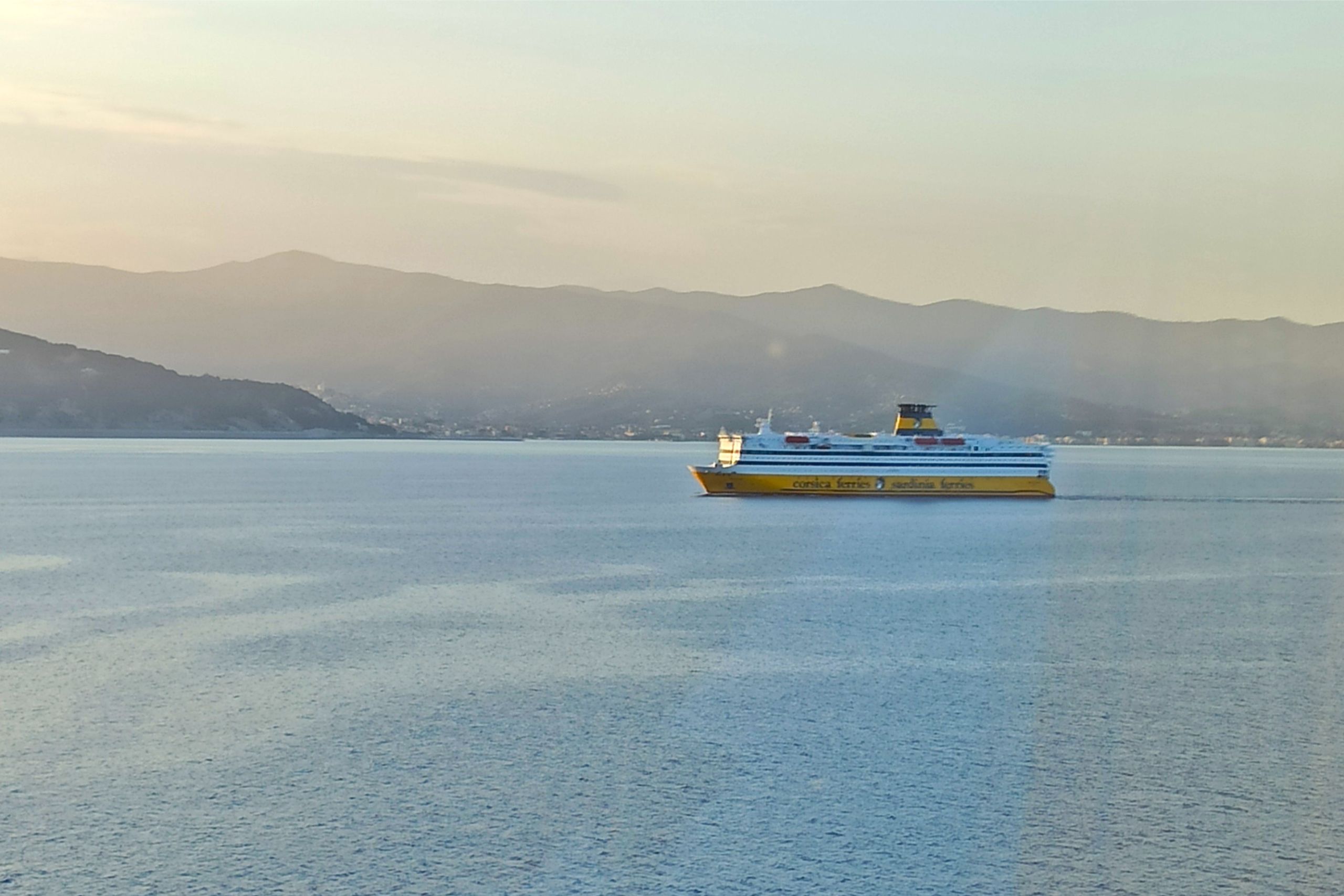
The need for continuous observations is precisely what led CIMA Research Foundation to use commercial ferries as research platforms. Since 2008, through its collaboration with Corsica Ferries–Sardinia Ferries, CIMA has been part of the FLT Med Network, the Mediterranean monitoring network coordinated by ISPRA (the Italian Institute for Environmental Protection and Research). This long-term activity has been supported by several projects, including the European LIFE CONCEPTU MARIS project, dedicated to the conservation of cetaceans and sea turtles, and, more recently, SEAsteMAR, which contributed to monitoring activities during the summers of 2025 and 2026.
During ferry crossings, trained observers record the species encountered, the location of each sighting and the estimated number of individuals. Regular ferry routes thus make it possible to collect data repeatedly along the same stretches of sea, building a body of knowledge that grows season after season.
The map of sightings from summer 2026 shows a series of coloured points along the monitored ferry routes. Each point represents an encounter with one of the seven species recorded, from groups of striped dolphins to the much larger fin whales.
Taken individually, these observations capture only a brief moment in the life of the Pelagos Sanctuary. But when combined with data from previous years, they help piece together a much broader picture.
Summer 2026 therefore reminds us that, to understand how the Mediterranean is changing, it is not enough to study exceptional seasons: it is equally important to continue monitoring those that, at least according to the available data, appear ordinary.


