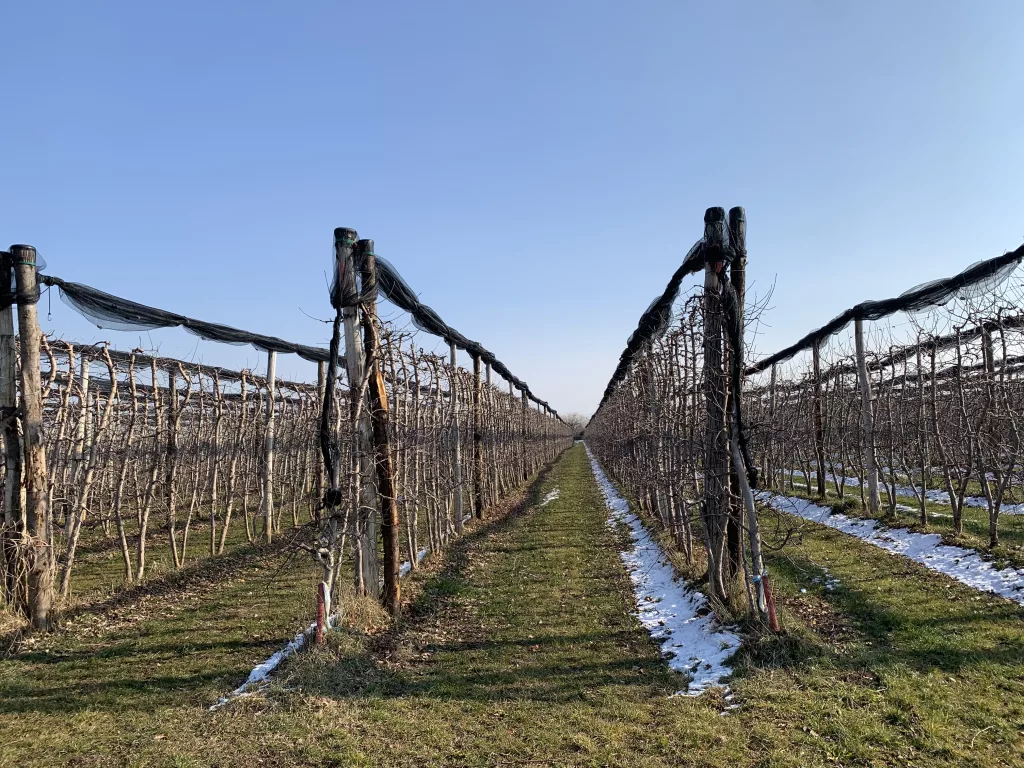
Agriculture is one of the sectors most vulnerable to the impacts of climate change. The H2020 MAGDA project focuses on addressing this issue. As project partner, CIMA Research Foundation will contribute to the development of an automated weather forecast system, achieved through the assimilation of observational data into forecasting models. This system will aim to optimize agricultural activities
During the last months, droughts and violent hailstorms strained crops in several areas of Italy, especially in the north. But do we have ways to predict these events and, thus, be able to protect farmers?
The goal of the MAGDA project, funded under the European H2020 program, is to improve weather forecasts, especially for the most intense events that pose the highest risk to agriculture. The CIMA Research Foundation’s task, as a partner of the project, is to is to enhance the efficiency of numerical models used in weather forecasting through a procedure of observational data assimilation, focusing on the short and medium term. This summer, our researchers began a series of preliminary activities that will allow us to start simulations on three specific study areas identified within the MAGDA project.
Meet MAGDA
Begun in November 2022, MAGDA is a project that “Wants to develop a suite of tools for meteorological and hydrological monitoring to support agriculture through a system, called Farm Management System. This system can provide targeted forecasts and warnings in case of adverse events, such as heavy rain, hail, or heat wave, to farmers,” says Martina Lagasio, researcher of the Meteorology and Climate Department of CIMA Research Foundation. “One of the distinctive aspects of the project is the integration of observational information from various sources to improve the forecast skill. These sources include ground survey stations, meteorological radars, meteodrones and the global navigation satellite system (GNSS). By assimilating data into the WRF weather model, the project aims to by providing the model with the most current and realistic information about the state of the atmosphere.”
Indeed, numerical models rely on a set of parameters and variables to establish initial conditions. By integrating this information with the assimilation, which involves real-time observations, it is possible to enhance the reliability and accuracy of the model’s results.
MAGDA’s main focus is on advancing and expanding the utilization of observational data from different sources, providing high-resolution meteorological and hydrological forecasts. Besides the scientific aspects, the project also addresses socio-economic implications. The techniques under investigation will in fact be a concrete support to farmers. “The forecasts will be valuable for farmers and others in the agricultural sector, enabling them to make informed decisions on aspects like irrigation timing and installation of protective structures such as hail nets,” Dr Lagasio says.
From preliminary runs to data assimilation
Although MAGDA also includes a hydrological forecasting and modeling component, the CIMA research Foundation’s role in the project is primarily related to weather forecasting. Currently, researchers are conducting what are referred to as “preliminary runs”, which involve a set of simulations to identify modelling errors through statistical methods to optimize the assimilation procedure. “We are working on three different study areas located in Italy, France and Romania. Each is characterized by different types of crops: predominantly orchards in Italy, vineyards in France, summer crops such as corn, sunflower and soybean in Romania. This allows us to address different needs. For example, orchards are usually already protected by hail nets, and the interest of operators is more related to the best time for applying pesticides and fungicides. On the other hand, all the different crops share the need to efficiently organize and schedule irrigation,” Dr Lagasio says.
Meanwhile, over the past few months, the project has expanded the network of ground-based sensors contributing to data collection. In the three study areas, additional GNSS monitoring units and metIS hubs, designed to collect information on water vapor in the atmosphere, soil moisture, temperature and other variables, were installed. “Integrating such different data from each other, some of which are still underutilized at the operational level, poses one of the greatest scientific challenges. In addition, we must address the complexities of establishing a fully automated system and ensure that alerting farmers and operators in the field is clear and effective while considering the inevitable spatial and temporal uncertainties of the forecasting models,”, says Dr Lagasio.
A matter of adaptation
Being able to support farmers in organizing their activities is not just an economic issue. “The Farm Management System developed within the project tries to help reduce crop losses and the risk of wasting water for irrigation, thus placing itself in line with the Sustainable Development Goals of the Agenda 2030,” Dr Lagasio continues.
In addition, the activities and results of MAGDA project represent a form of adaptation to climate change. Altered weather patterns can damage crops in various ways: water shortages or, conversely, excessive crop flooding; late frosts, hailstorms, hurricanes and extreme temperatures. As a result, understanding and predicting these events have become increasingly essential to implement appropriate protective and impact mitigation measures.
“Scientific research, both basic and applied, plays a crucial role. Fortunately, we now have access to an increasing amount of data and information, and it is our responsibility to learn how to integrate and utilize it effectively, tailoring it to different contexts, as we are doing within MAGDA,” Dr Lagasio concludes.