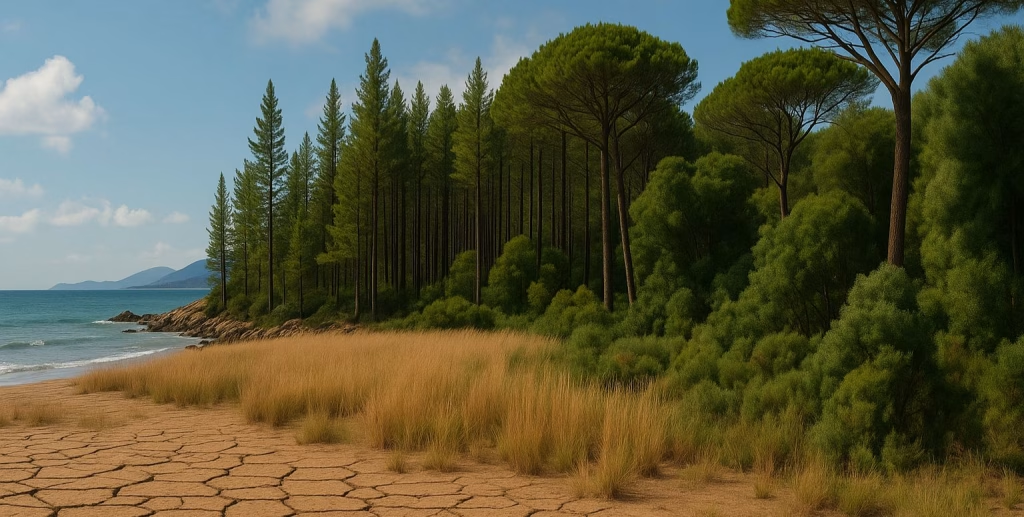
Biodiversity is an essential feature of the biosphere. It is also a form of collective intelligence—an adaptive, self-regulating system that reshapes itself in response to change. It is a memory: every species, every organism, every ecological cycle holds the imprint of millennia-old dynamics. But there comes a point when this intelligence falters. When environmental and anthropogenic pressure exceeds the threshold of resilience, biodiversity is compromised.
Today, among the main drivers of ecological pressure, drought stands out as a key phenomenon: transversal, intensifying, and systemic. It is not merely an extreme weather event but a process capable of deeply altering ecosystem functioning. When drought strikes environments already stressed by other factors—urbanization, pollution, habitat fragmentation—it becomes a transformative force. It alters species composition, favoring more resilient, generalist species that are potentially less functional, and reduces the structural complexity of ecosystems. Some ecosystems collapse; others shift into simplified, impoverished configurations. In both cases, biodiversity is reduced, ecological meaning is lost, and systemic value diminishes. The issue is not only species loss. It is the loss of function.
To understand these dynamics and their impact on biodiversity, CIMA Research Foundation has analyzed data from the World Drought Atlas, one of the most comprehensive sources of global climate information, and integrated them with the operational perspective developed within the National Biodiversity Future Center (NBFC). This scientific, technical, and applied knowledge base guides the development of tools for observing, interpreting, and safeguarding natural systems. Because biodiversity is not just a value to be preserved—it is the very condition for the resilience of life on Earth.

When carbon, water, and climate regulation stop functioning
The carbon cycle, for example, is deeply intertwined with the health of vegetated ecosystems. During prolonged drought, plants reduce photosynthetic activity and their capacity to absorb atmospheric CO2. They also release less water vapor, exacerbating drought conditions. Under these circumstances, natural ecosystems are less able to cool their surroundings, leading to increased heat and triggering a climate feedback loop that intensifies drought events.
Meanwhile, animal communities face dual pressures: water and food scarcity on one side, and habitat loss or transformation on the other. Trophic interactions are disrupted, life cycles desynchronized, and many species lose the seasonal cues that regulate migration, reproduction, or flowering. Ecosystems that may still appear green or inhabited begin to lose essential, though invisible, functions.
Some of these transitions are irreversible. This is the case for terrestrial ecosystems that pass a critical tipping point and reorganize around new ecological dynamics, becoming less diverse and less capable of withstanding future pressures. Similar transformations can occur in marine and coastal ecosystems, though through different mechanisms.
The sea, silently changing
The marine environment, often perceived as distant from the effects of drought, is in fact undergoing significant change. Reduced river discharge caused by drought, along with increasingly frequent marine heatwaves, alters salinity and temperature in coastal waters. Nutrient cycles are disrupted, planktonic balances at the base of the food web are affected, and the resilience of seagrass meadows and coral reefs declines.
These dynamics impact marine biodiversity in ways that are not always immediately visible, but are profound. Some species shift toward cooler waters, while others fail to adapt and disappear locally. The combined effects of drought, global warming, and ocean acidification create complex scenarios that are difficult to predict and even harder to manage.
In this context, integrated monitoring, marine flow modeling, and habitat change forecasting become essential. Marine biodiversity is not only a matter of beauty—it underpins climate regulation, sustainable fisheries, and responsible tourism. To protect it is to safeguard vital planetary functions.
The forest threshold
Mediterranean forests are adapted to aridity—but not to extreme aridity. Prolonged heatwaves and months-long droughts place intense pressure on tree species, disrupt natural regeneration, and increase the frequency and intensity of wildfires. Soil water balance is altered, litter decomposition slows, and pathogenic insects spread more easily.
Forest biodiversity responds to these stress signals through gradual shifts: some tree species slow their growth; others are replaced by pioneer species that are more stress-tolerant but less ecologically functional. Animals that depend on these plants for food and shelter must relocate, adapt, or disappear. It is a silent but profound process that can lead to a functional simplification of forest ecosystems.
To detect these thresholds before they are crossed, high-resolution observation tools, eco-hydrological models, and integrated monitoring networks are essential. It is necessary to understand the dynamics of living species, soil, surface and groundwater, and the flow of matter and energy—what together defines the Critical Zone, the thin layer at the Earth’s surface where ecosystems develop. Only then is it possible to detect early-warning signals of change, those that precede irreversible transformations.
Biodiversity as ecological safety infrastructure
Biodiversity is not something to preserve only for ethical or aesthetic reasons. It is an ecological safety infrastructure: it provides us with food, water, clean air, and protection from natural hazards. It is a network of ecosystem services that sustains the functioning of the planet.
Within the framework of the National Biodiversity Future Center (NBFC), a systemic vision of this infrastructure is taking shape—one grounded in the integration of observational data, predictive modeling, monitoring technologies, and decision-support tools. Forests and marine environments are studied; resilience thresholds are analyzed; tools are developed to anticipate and manage ecological transitions and address challenges for effective environmental conservation.
CIMA Research Foundation contributes to this vision through its expertise in marine biodiversity research, with a specific focus on pelagic top predators. Within Spoke 2—which aims to develop solutions to reverse marine biodiversity loss and manage marine resources sustainably—our researchers work to map species distribution and movement, assess the impact of human activities, forecast future scenarios under climate change, and improve marine monitoring technologies. Top predators are also used as mobile oceanographic sensors, providing valuable insights into the health of offshore ecosystems.
Special mention
Anxo Gende Soane, participant in the Cetasmus program at CIMA Research Foundation, received the Best Scientific Poster Award at the 36th Annual Conference of the European Cetacean Society. The awarded research, conducted within the activities of the NBFC, is titled: “Improving cetacean body length estimation using aerial photogrammetry: addressing the impact of body curvature and surfacing variability.”
This innovative study contributes to improving the accuracy of aerial photogrammetry techniques for estimating cetacean body length by accounting for morphological variability during surfacing. It represents an important step toward increasingly accurate and non-invasive monitoring techniques for the study and conservation of marine megafauna.
CIMA Research Foundation is also involved in Spoke 4 – Ecosystem Functions, Services, and Solutions, with a specific focus on the impacts of wildfire propagation on ecological dynamics. This work is developed within a highly multidisciplinary context that fosters synergy across specialized scientific sectors.
The Foundation’s contribution centers on the development and application of digital tools, predictive models, and monitoring platforms to assess fire impacts on terrestrial ecosystems and to support climate adaptation strategies based on Nature-based Solutions (NbS).
Special attention is given to the effects of fire intensity on the physical, chemical, and biological properties of soil, which profoundly influence the post-fire regenerative capacity of Mediterranean ecosystems. High-intensity wildfires can damage soil structure, increase hydrophobicity, reduce fertility, and drastically alter microbial and fungal communities, with direct consequences for plant recolonization. However, many Mediterranean species have evolved specific adaptations to recurring fire, such as heat- or ash-triggered germination, regrowth from protected underground organs, and rapid seed dispersal—traits that confer notable regenerative capacity.
Biodiversity is in constant evolution. It is not a catalog of species preserved under glass. It is dynamic, relational, and closely linked to anthropogenic pressure. Its continuous transformation can lead to a loss of complexity and diversity, increasing the vulnerability of entire socio-ecological systems.
Recognizing signals, measuring impacts, and building tools to anticipate thresholds: this is the task of science today. A science that does not merely describe the world, but works to guide its transformation toward more sustainable forms of coexistence.
In a world that is changing, biodiversity is the very condition that allows us to keep changing.